
Designing with Air: A Simulation-Based Approach to Thermal Comfort
Calibrating Airflow Through Spatial Configuration in Tropical Architecture
PROJECTSDESIGN RESEARCH
Natthaphan Sukonthaphan
4/30/20265 min read
Introduction
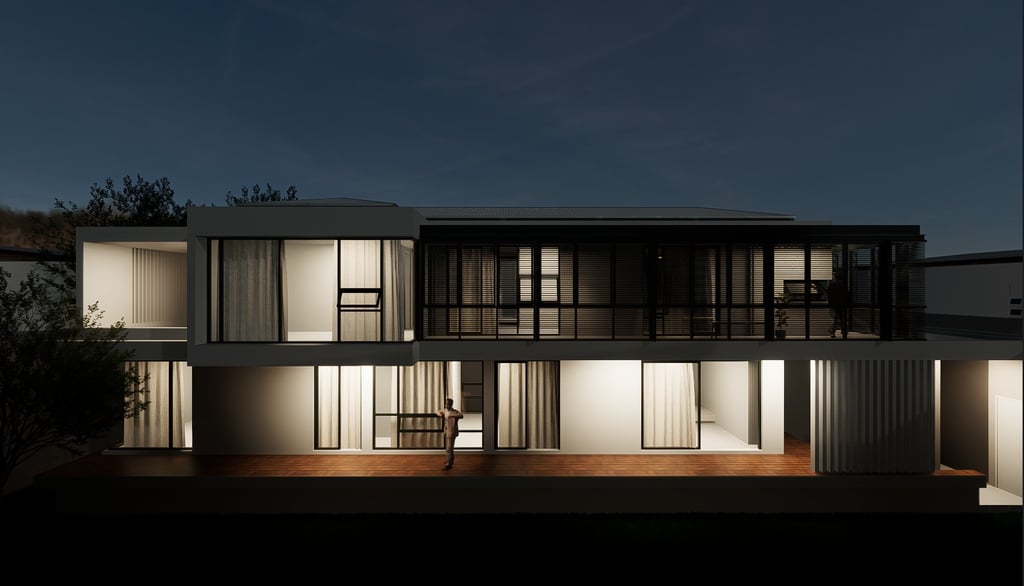
Thermal comfort in tropical architecture is shaped not only by temperature, but by the movement of air within space. In climates defined by heat and humidity, airflow plays a critical role in dissipating heat and reducing perceived temperature. However, its effectiveness depends not only on the presence of airflow, but on how it is distributed across space.
Rather than treating airflow as a passive outcome of design, this study defines air as a calibrated environmental system. Through simulation analysis, airflow becomes measurable, testable, and designable—allowing spatial decisions to be refined based on performance rather than assumption.
Airflow as a Calibrated Spatial System
This study operates at the spatial scale, focusing on how airflow can be calibrated within interior space through precise adjustments to opening configuration and spatial layout.
Small spatial interventions—such as the size, position, and type of openings—can significantly reshape how air enters, moves through, and exits a building. By analyzing internal flow velocity, the study reveals zones of stagnation, imbalance, and acceleration.
However, increasing airflow alone does not guarantee improved comfort—balanced distribution across space is critical. The design therefore focuses on calibrating opening configurations to regulate airflow direction, velocity, and spatial continuity.
Findings: Airflow Calibration Through Openings
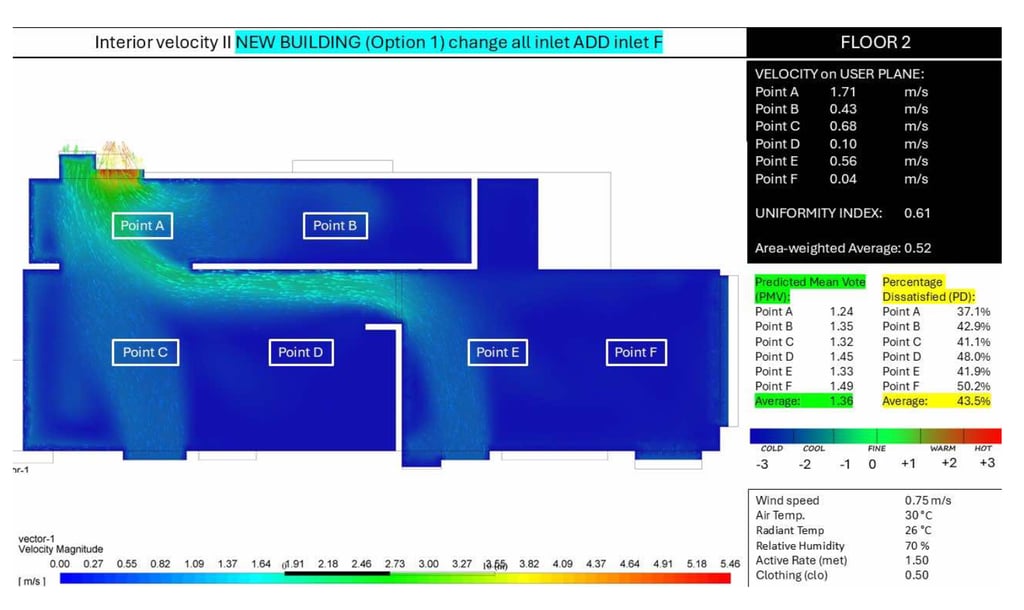
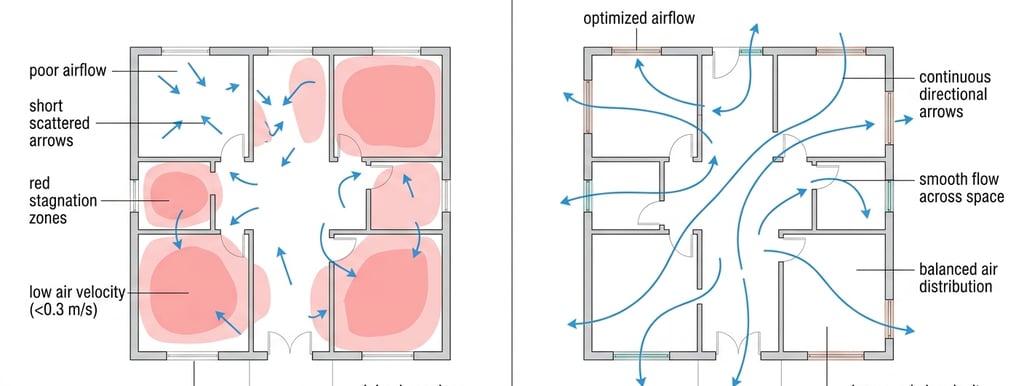
Airflow performance improves significantly following these modifications. Air velocity increases toward the effective comfort range of approximately 0.5 m/s, enabling more continuous airflow and reducing stagnation zones.
However, the results also reveal that airflow improvement is not uniformly distributed. Despite the overall increase in velocity, certain areas experience reduced airflow due to imbalanced pressure conditions and disrupted flow paths.
This demonstrates that airflow performance is not defined by velocity alone, but by how effectively it is distributed across space.
Simulation Framework
The simulation is conducted under representative tropical conditions:
External wind speed: approximately 0.75 m/s
Outdoor temperature: approximately 30°C
Performance is evaluated through three key indicators:
Predicted Mean Vote (PMV)
A measure of perceived thermal comfort, where values approaching 0 indicate optimal conditions.
Uniformity Index (UI)
A measure of airflow consistency, where values approaching 1 indicate stable and evenly distributed airflow.
Air Velocity
An indoor air velocity of approximately 0.5 m/s is considered effective for passive cooling without discomfort.
Conclusion
This study establishes airflow as a calibrated spatial system within tropical architecture. By controlling how air enters, moves through, and distributes across space, architects can improve environmental performance and indoor comfort.
However, airflow calibration alone does not fully resolve thermal comfort. While air movement enhances perceived cooling, it also introduces external thermal load into the building.
This reveals a second challenge: not only to shape how air moves, but to control the heat it carries.
Designing with air is therefore not only about enabling movement, but about controlling its environmental consequences.
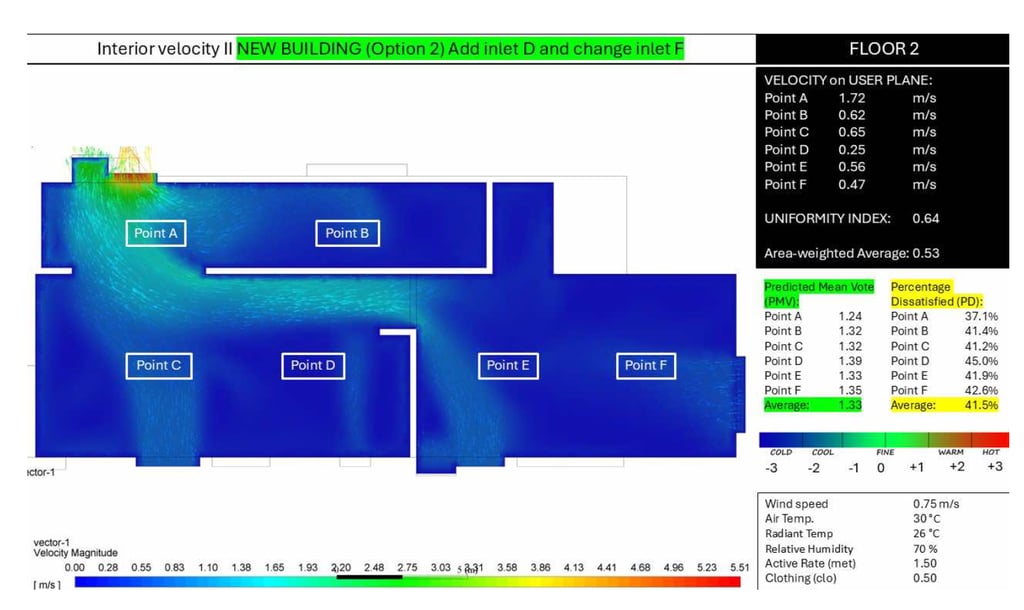
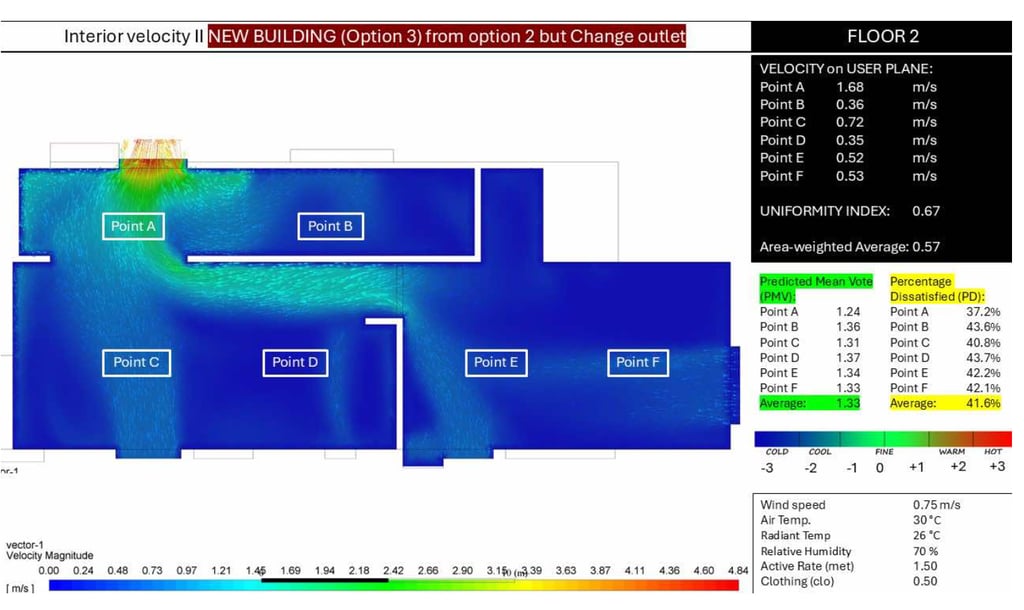
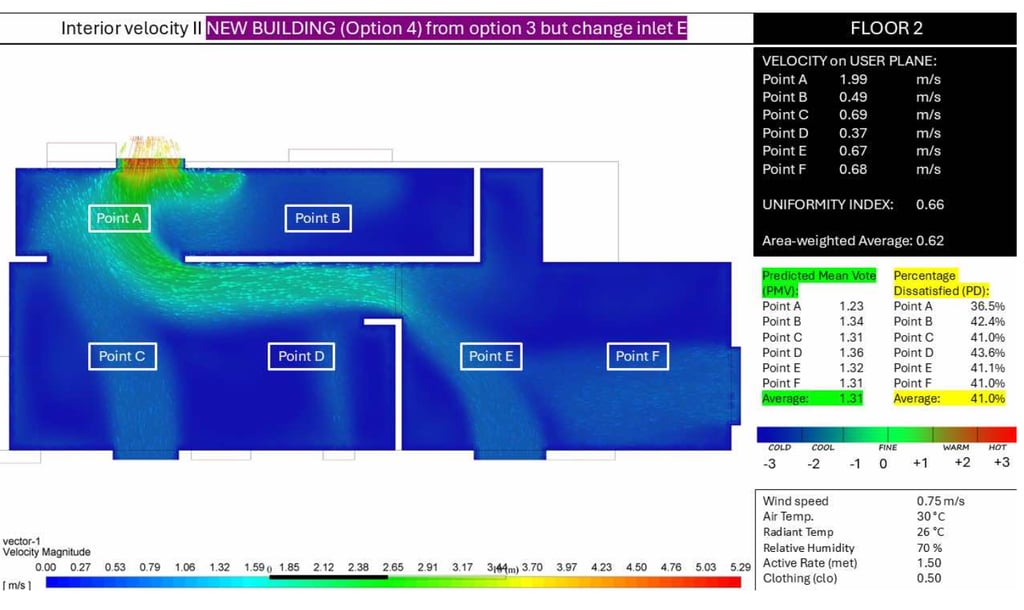
Further Design Iterations (Analysis 3–5)
Based on the initial findings, three additional design scenarios are proposed to further refine airflow performance:
Analysis 3
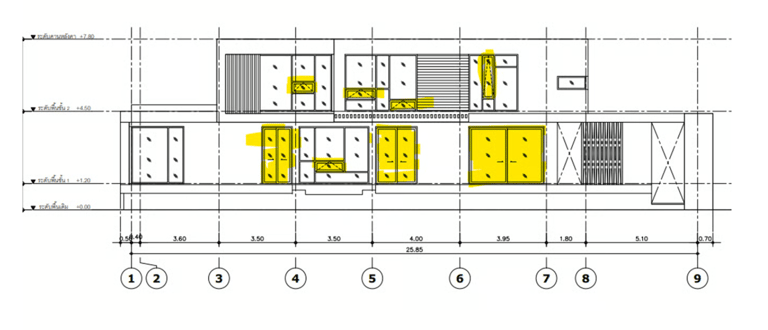
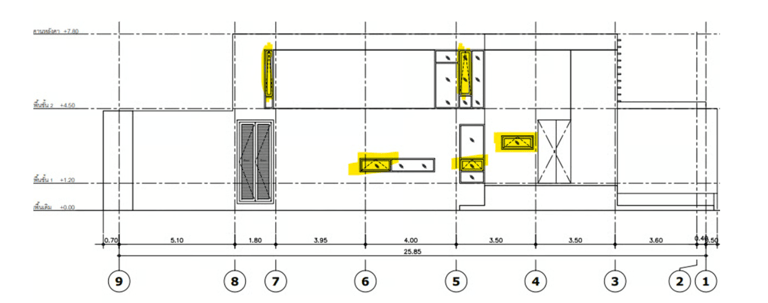
An additional air inlet is introduced at Point D, while the opening at Point F is modified into a sliding window.Analysis 4
An air inlet is introduced at Point D, while the openings at Points A and F are changed from casement windows to sliding windows.Analysis 5
An air inlet is introduced at Point D, while the openings at Points A, E, and F are changed from casement windows to sliding windows.
Acknowledgment
Special thanks to Siree Thirakomen, MSc Renewable Energy and Architecture, University of Nottingham, for conducting the simulation analysis.
Simulation Analysis Chart 1
Simulation Analysis Chart 2
Simulation Analysis Chart 3
Simulation Analysis Chart 4
Simulation Analysis Chart 5
East Elevation
West Elevation
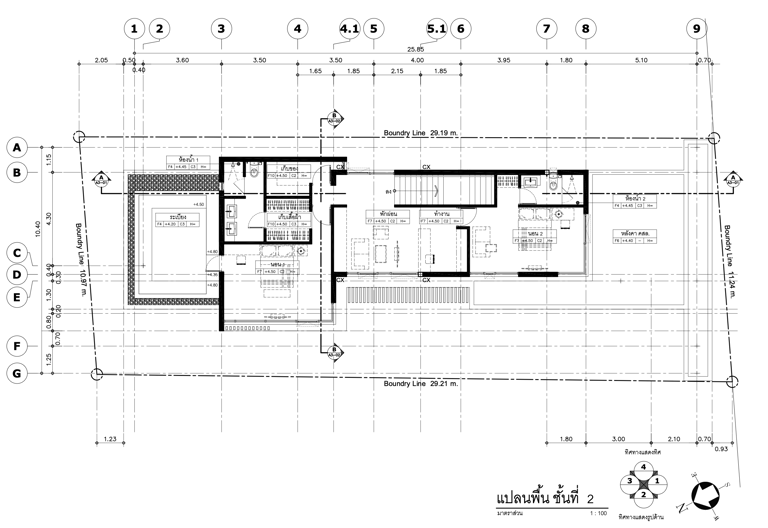
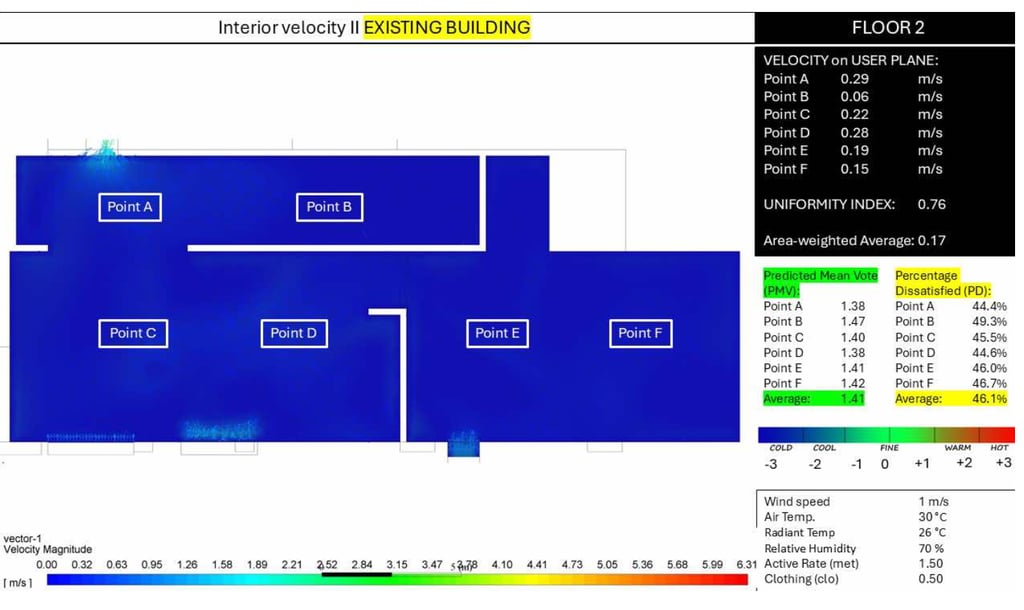
2nd floor Plan(Existing)
Initial simulations indicate that under existing conditions, internal airflow remains limited, with velocities across most zones below 0.3 m/s, resulting in insufficient ventilation and localized stagnation.
Modified Opening Configuration (Analysis 2)
Through adjustments to opening size, position, and configuration, airflow behavior improves significantly. Cross ventilation is enhanced, enabling air to move more continuously through primary occupied spaces.
For example, airflow velocity at key areas increases from 0.22 m/s to 0.68 m/s, representing a substantial improvement in ventilation performance.
Keywords: Thermal Comfort, Airflow Simulation, Tropical Architecture, Passive Design, Natural Ventilation, Spatial Calibration, Internal Flow Velocity
Discussion
The study demonstrates that airflow is not a fixed environmental condition, but a design variable that can be calibrated through spatial decisions. Small adjustments to openings can significantly reshape airflow behavior by altering pressure relationships and flow continuity.
Importantly, increasing airflow alone does not guarantee improved comfort. Effective airflow design depends not only on velocity, but on its continuity, stability, and spatial distribution.
Simulation plays a critical role in this process, enabling architects to test design scenarios, identify imbalances, and refine spatial strategies based on measurable performance.
These iterations demonstrate that airflow calibration requires more than increasing the number of openings. It requires precise coordination between opening placement, window type, airflow paths, and spatial configuration.
Design Strategies
The study identifies four key strategies for designing with air at the spatial level:
1. Calibrating Opening Configuration
Openings act as control devices that regulate airflow direction, velocity, and distribution
2. Enabling Cross Ventilation
Aligning openings across spaces supports continuous airflow and reduces stagnation
3. Supporting Vertical Air Movement
Voids and double-height spaces facilitate stack effect, allowing warm air to rise and escape
4. Balancing Air Distribution
Airflow must be evenly distributed across occupied zones to avoid localized discomfort
Airflow performance is not defined by velocity alone, but by how effectively it is distributed across space.
Comparative Analysis
Modified Condition
Existing Condition
Key Insight
Airflow performance is not defined by velocity alone, but by how effectively it is distributed across space.