
Designing with Air: Reducing Heat Gain Through Environmental Mediation
A System Strategy for Controlling Airflow and Thermal Load in Tropical Architecture
PROJECTSDESIGN RESEARCH
Natthaphan Sukonthaphan
4/30/20263 min read
Introduction
While airflow calibration improves thermal comfort within space, it does not operate independently from external environmental conditions. In tropical climates, incoming air often carries significant thermal load, particularly when combined with direct solar exposure.
This study extends the airflow framework by addressing a broader question:
how can architecture not only enable air movement, but also control and condition it before it enters the building?
Approach: Air as a Mediated System
If airflow within space can be calibrated, then airflow at the building scale must be mediated.
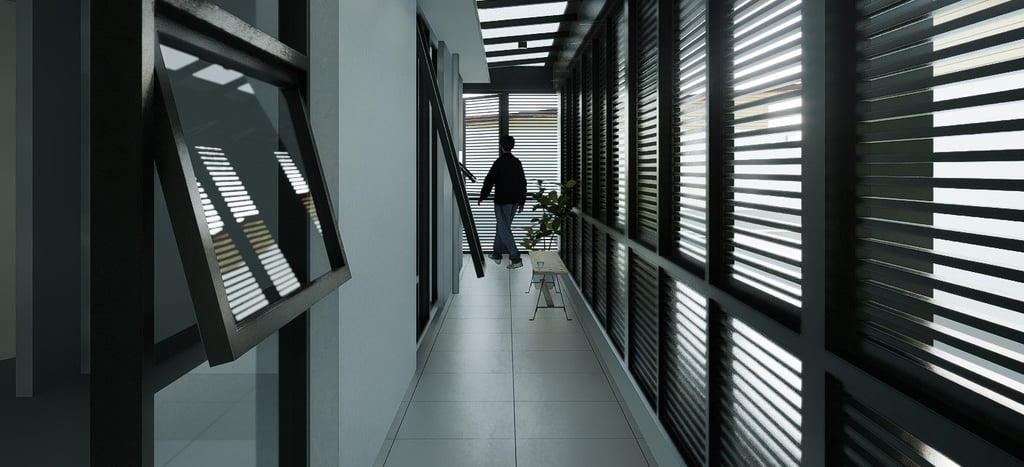
This study reframes the building envelope as a layered environmental system, rather than a single boundary. Instead of allowing direct interaction between exterior climate and interior space, the design introduces intermediate layers that filter, reduce, and stabilize environmental forces.
The objective is to transform incoming air from a raw climatic input into a conditioned environmental flow.
System Strategy: Double Façade Implementation
To achieve this, a double façade system is introduced, particularly along the western façade, where solar radiation is most intense.
The system consists of:
An outer layer that reduces direct solar exposure
An intermediate semi-outdoor space that acts as a buffer zone
An inner building envelope that receives moderated environmental conditions
This layered configuration allows the building to interact with climate progressively, rather than directly.
Note / Acknowledgment
Special thanks to Siree Thirakomen, MSc Renewable Energy and Architecture, University of Nottingham, for conducting the simulation analysis.

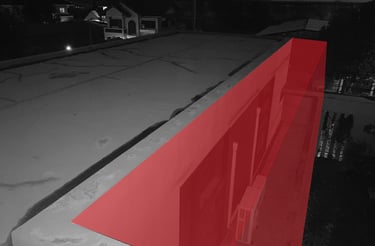
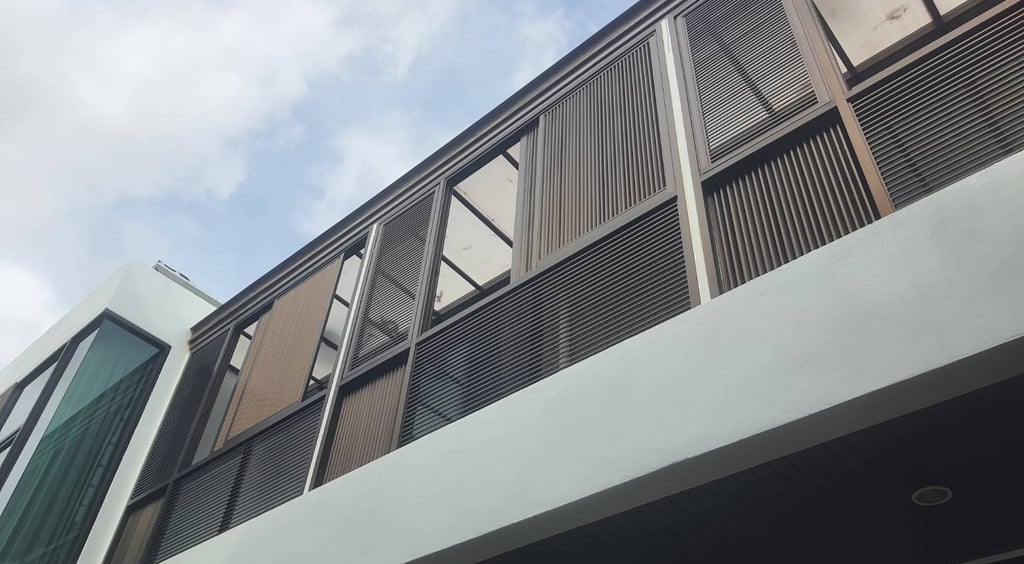
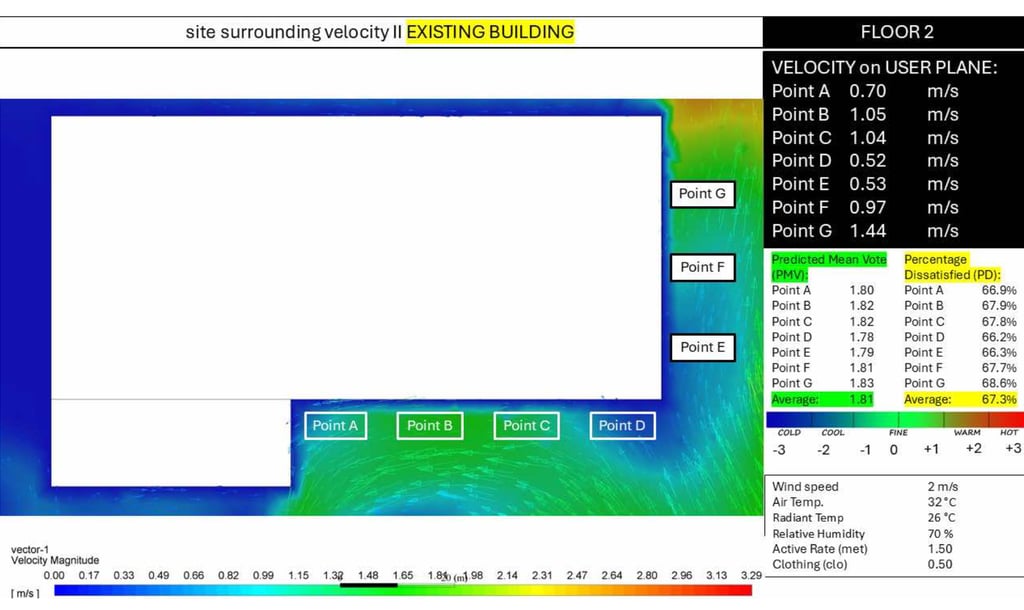
Simulation Analysis Chart 1
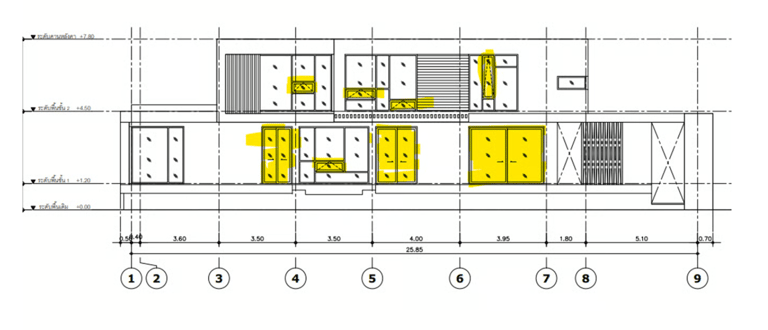
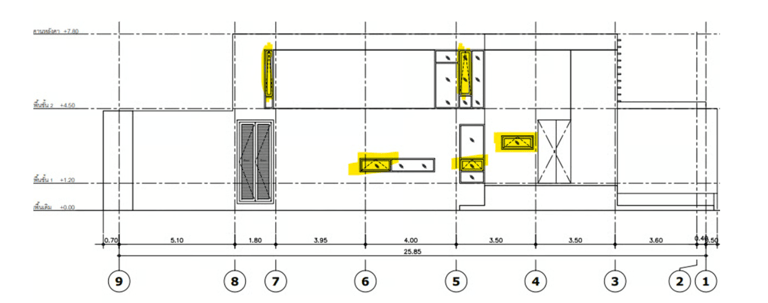
Overview of the current construction facade
East Elevation
West Elevation
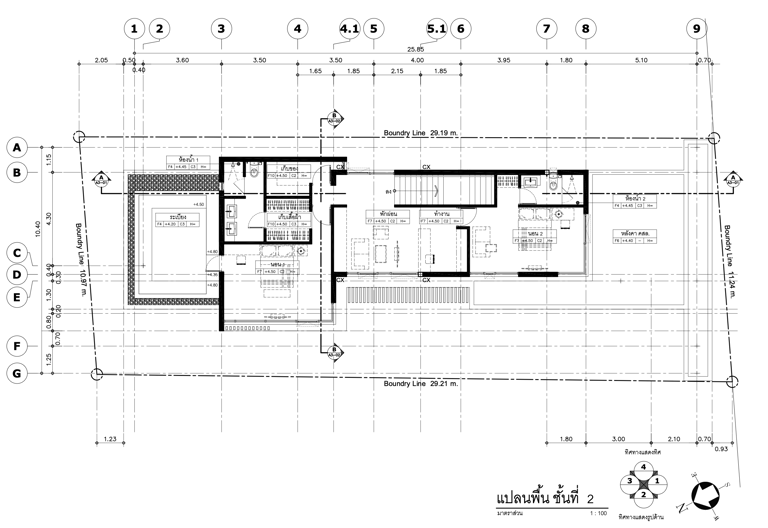
2nd floor Plan(Existing)
The highlighted area (in red) indicates the zone designated for the implementation of the double façade, strategically designed to mitigate solar heat gain from the western exposure.
Simulation Methodology
Comparative simulations are conducted under consistent tropical conditions:
External wind speed ≈ 0.75 m/s
Outdoor temperature ≈ 30°C
Two scenarios are evaluated:
Existing condition without environmental mediation
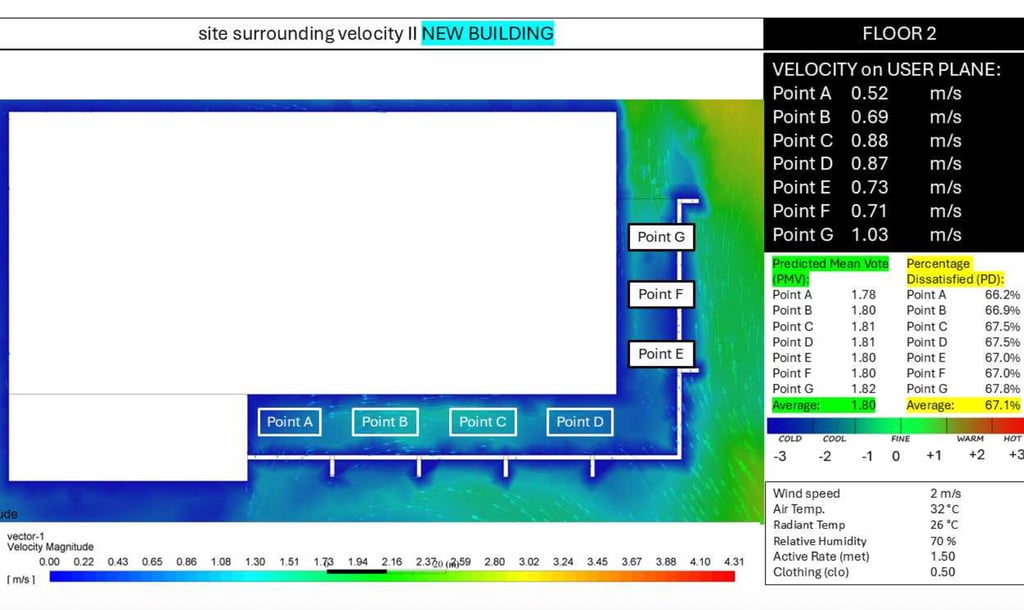
Proposed condition with double façade system
The analysis focuses on:
Airflow velocity reduction
Heat transfer mitigation
Stability of internal environmental conditions
Simulation Analysis Chart 2
Conclusion
This study establishes a system-level strategy for reducing heat gain in tropical architecture. By integrating shading, airflow modulation, and transitional space into a unified envelope system, the building achieves more controlled and stable environmental performance.
Keywords: Thermal Comfort, Double Façade, Airflow Simulation, Heat Gain Reduction, Tropical Architecture, Passive Design
Findings: From Direct Exposure to Environmental Filtering
Simulation results demonstrate that the introduction of the double façade significantly alters airflow and thermal behavior:
Incoming air velocity is reduced as it passes through the buffer zone
External heat carried by airflow is partially dissipated before reaching the interior
Internal conditions become more stable and less exposed to fluctuation
The semi-outdoor space functions as a transitional environmental layer, where air is slowed, filtered, and tempered.
Discussion
The findings demonstrate that improving comfort is not solely about increasing airflow, but about controlling the quality of that airflow.
By introducing a layered system, the design shifts from direct exposure to environmental mediation. Air is no longer treated as a neutral or beneficial force by default, but as a variable that must be conditioned based on context.
Simulation plays a crucial role in validating this system, allowing designers to quantify how airflow and heat interact across different layers of space.
Design Strategies: Controlling Environmental Flow
The study identifies key strategies for managing airflow and heat at the building scale:
Reducing Direct Solar Exposure
The outer façade layer blocks and diffuses solar radiation, particularly from western orientationModulating Airflow Velocity
The buffer zone reduces the speed of incoming air, limiting heat transferCreating Transitional Environmental Space
Semi-outdoor zones act as climatic filters between exterior and interiorLayering the Building Envelope
Multiple layers allow environmental forces to be processed gradually rather than abruptly